
The World Cup Finals Import vs. Domestic event has been held at Maryland International Raceway (MDIR) for 29 years, and the highly anticipated event once again brought the excitement for its thirtieth year.
Normally bringing cool temperatures and some great track prep from the Sick Prep team, the World Cup Finals Import vs. Domestic event normally delivers some great racing, as well as record-setting runs.

After battling rain that eliminated an entire day of qualifying, Saturday’s final qualifying, and final eliminations on Sunday, November 8th brought edge of your seat excitement, whether you were part of the huge sell-out crowds, or watching live on FRDM+.
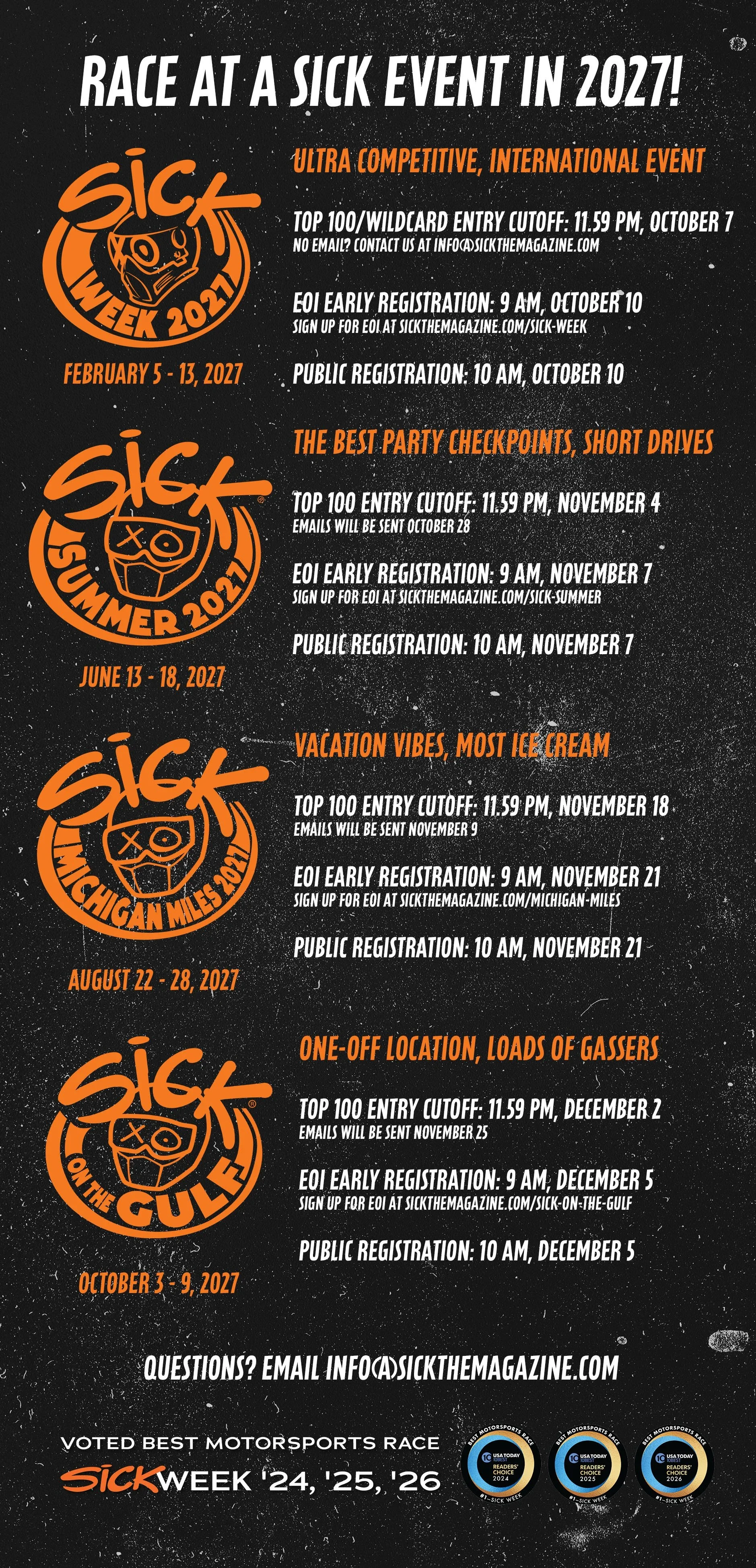
Your support of Sick The Magazine - the official print publication of drag and drive - as well as our events, has fueled us to offer SIX events for the 2027 season! Find out more by visiting the Sick The Magazine Event page by CLICKING HERE!
In the quickest class of the thirteen contested, the Outlaw vs Extreme class, Troy Pirez Jr. drove Cameron Johnson’s 1969 Camaro to his first World Cup Finals victory over Jerry Fernandez Jr. The team battled through not only discovering a broken engine upon arrival, but a broken transmission as well, after their first qualifying run.

In route to the final round, Pirez clocked a trio of runs between 5.753 and 5.734 in the ‘Eagle’ Camaro, a car that Cameron originally built for Cleetus McFarland, and recently bought back. Pirez saved his best run for last, a 5.711 at 245.45 mph, to take the measure of Fernandez’s 6.174 effort.
The domestics racked up their second win in two finals, when Ty Casper took the measure of Ferdinand Garcia in the Renegade vs Modified class. The 2005 Mustang driver scored a trio of upset victories to reach the final against Garcia, where Kasper recorded a 6.136 at 206.20 mph for the victory, while Garcia had issues and slowed to a 10 second pass.
In Warriors vs Tres Cuarto, number three qualifier Giomar Colon-Rodriguez put one in the win column for the imports. Wheeling the Mazda RX-7 known as ‘The Judge,’ Colon-Rodriguez put up a 6.205 at 225.71 mph in the final to turn back the 6.487 at 216.47 mph from Jon Lund’s Mustang.
One of the new classes to the WCF lineup for 2026 was Radial vs Shoeboxes, and an all import final round found the ‘71 Datsun of Eriel Morales getting the final win light with a 6.439 at 215.71 mph pass, over the ‘85 RX-7 of Ricardo Vazquez. This victory evened the Import vs Domestic score at two wins each.
The popular Stick Shift class was a highly anticipated one for this year’s WCF, and it delivered the excitement and record shattering performances both the crowds, and the drivers, were hoping for!
After setting a new Stick Shift record for both elapsed time and speed, with a 6.320 at 235.49 mph in the second round of qualifying, Brett LaSala saw the e.t. record snatched away from him just minutes later. Former record holder Nick Cole-Mann delivered a 6.306 at 231.95 mph pass from his 1991 Chevrolet S-10 pick-up, which is now sporting a new Steve Morris LS twin turbo combination.
Round one of eliminations was also a record setting affair, as LaSala once again set a new e.t. record, a 6.280 at 230.65 mph. But less than five minute later, Joel Grannas completed his first round six thousandths of a second quicker than LaSala, claiming the record for himself with a 6.274 at 230.57 mph pass, in his Compressed Air Supercharging 2JZ-powered Fox Mustang.
After a pair of winning 6.29-second time slips in rounds two and three, LaSala staged in the final round against fellow Floridian and Mustang driver, Yandro Ulloa, who clocked his first 6-second pass in round one. LaSala would seal the deal for his first Stick Shift win with a 6.416 at 213.20 mph, marking his third WCF win in four years, in three different classes.
The Street Fighter class had a pair of Fox Mustangs in the final round as well, as veteran WFC racer Adam Arndt staged up with 2026 PDRA champion Austin Vincent. The two drivers came into the final round with near identical performances, and Vincent got to the finish line first in his nitrous-assisted ride, 6.770 at 202.39 mph over the traction-limited 7.868 from Arndt.
The Wild Street final would be a Toyota versus Ford battle, as David Consentino’s Supra faced the Mustang of Kenneth Fox. The final round would be a wire-to-wire win for Consentino, as his 7.074 at 198.32 mph dispatched the 7.196 at 191.62 mph from Fox.
The Xtreme Front Wheel Drive brought 7-second passes and excitement in qualifying, as the bump spot was traded between three different drivers trying to get into the field on Saturday evening. One of those drivers was Canadian Max Leduc, who qualified his Honda Civic in the number fifteen spot with an 8.148 pass.
One day later, Leduc rolled into eliminations dialed in and clocking quicker passes through the rounds, enroute to the final round opposite number five qualifier Ricky Silva. After less than eight seconds of work, Leduc turned on the final win light with a 7.934 at 192 mph pass, evening the Import vs Domestic win tally at four wins each.
Two classes at World Cup have 32 car qualified fields, Limited Street and All Motor. The quicker of the two, Limited Street, would have the second all Mustang, all Floridian final of the day, with Brandy Lorence staging up opposite recent No Mercy winner Brad Schehr.
Schehr had the better performance heading into the final, but Lorence would make the most of her first final round appearance at WCF by taking the win, a 7.406 at 180.38 mph getting the nod over the 7.65 at 182.08 mph pass from Schehr.
The All Motor class is always a battle between domestic and import rides, and each side got a soldier to the final round. Number one qualifier Dan Ryntz staged his Mustang against the Honda Civic of Brandon Jefferson in the title match, and although Jefferson got a slight holeshot at the starting line, it would be Ryntz getting the win with the quickest time of the day, a 9.190 at 144 mph over the competitive 9.265 at 149.07 mph from Jefferson.
The second class to make its debut at this year’s WCF was the DAM Shootout (D standing for DCT transmission, A for All wheel drive, and M for mid-engine). The final round would be a pair of all-wheel-drive models, as Khalid Alreraei’s GT-R staged opposite the Honda of Daniel Rameriz.
The final round results would be one-sided, as Alrefaei’s GT-R rocketed to a 6.922 at 216.24 mph, while Ramirez‘s car barely moved off the starting line with problems.
The third new class to join the WCF lineup was the Overdrive Shootout class. It would also be the second class of the event where the number one qualifier survived to the final round, where Andrew Mallon’s BMW would meet Jon Sipple’s Dodge Challenger. Unfortunately, the final round would be decided before burnouts began, as Sipple’s car was unable to start at the ready line, giving Mallon a single for the victory, and ending the Import vs Domestic score with each side having six class victories.
The radical Pro Street Bike class showcases riders brave enough to travel the quarter mile in 6.3 seconds at over 230 mph. Defending class champion Jason Dunigan qualified number one at 6.399 at 235.64 mph, and in the final round Dunigan would face a familiar foe, number two qualifier Justin Shakir.
The pair of riders staged up, knowing just over six seconds later, the win light would shine for one of them. That magical light would turn on in Shakir’s lane, with a 6.372 at 236.71 mph pass getting Shakir his first WCF victory, a competitor who has participated in WCF since the Pro Street Bike class was added in 2018.
Written by Derek Putnam. Media courtesy of Motion Raceworks.
If you have thoughts / feedback / ideas, please e-mail us at derek@sickthemagazine.com